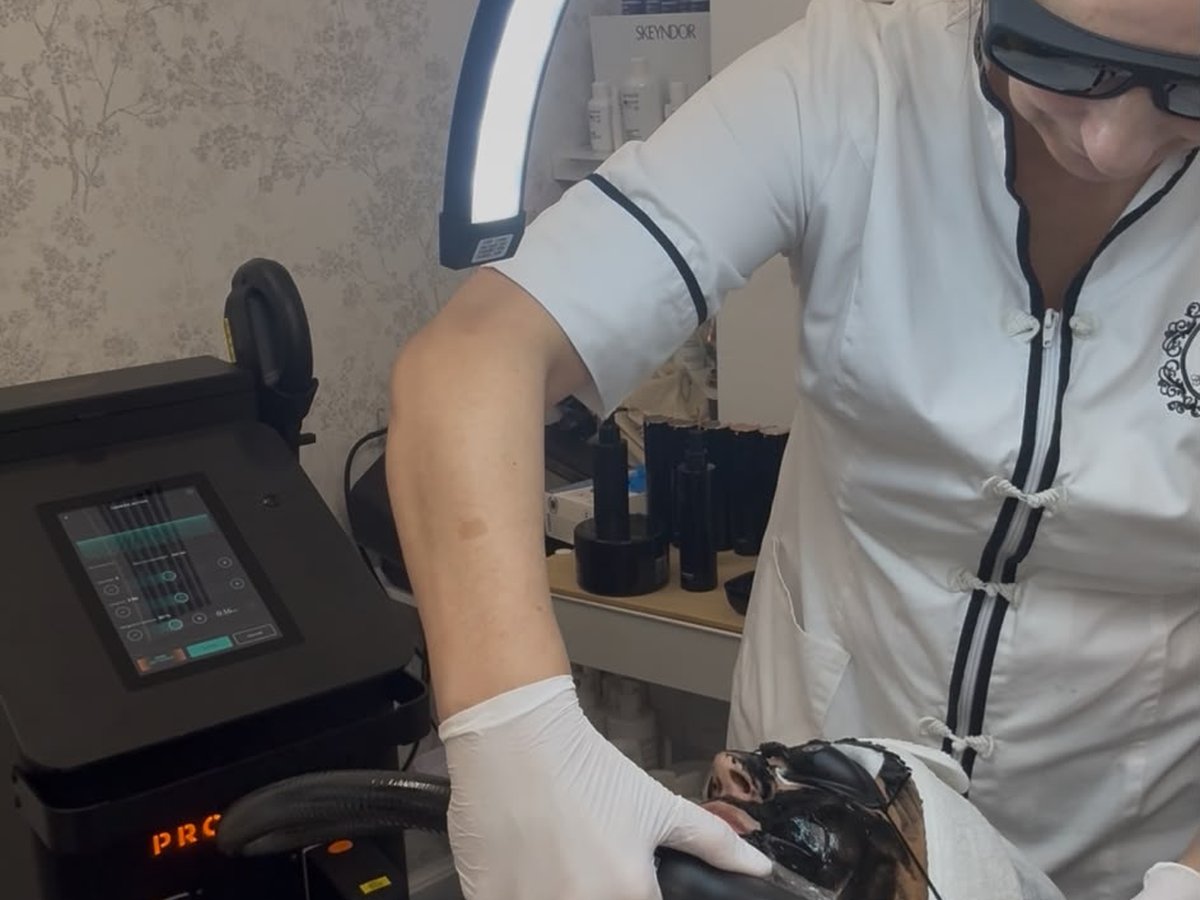
The activated charcoal peel with FHOS Bioluminescent Procyon is now running in the treatment room. It's the first of the FHOS protocols that we are officially launching in Campo Real, and the one most people had asked us to try: a bamboo charcoal mask applied to the face and activated with the athermal light of the Procyon. 60-minute session at 80 €, painless, with no downtime and suitable year-round.
What the activated charcoal peel is
The activated charcoal we are talking about isn't just any charcoal: it's bamboo charcoal, a natural-origin cosmetic ingredient with a very particular feature — its porous structure at the microscopic level. That porosity is what gives it its key function on the skin: absorption. It absorbs oil, impurities, surface residue and dead cells.
It has been used in professional aesthetics for years as a detox ingredient in masks and cleansers. What we are now doing in the treatment room takes it a step further: we apply the mask and activate it with FHOS light. The Procyon light "works" the mask from the outside, letting the actives reach further and making the exfoliating and purifying effect far more intense than a mask applied on its own.

How we do it in the treatment room: the 5-step protocol
A complete treatment, not a quick pass. Here is the step by step, exactly as it happens in the Campo Real treatment room:
- 1 · Prior diagnosis. We check skin type, sebum level, pore condition and whether there are post-acne marks or uneven texture. Without a diagnosis we don't start.
- 2 · Initial deep cleanse. Double cleanse to remove make-up residue, pollution and surface sebum. Preparing the skin is half the work.
- 3 · Charcoal mask application. We spread a uniform layer over the whole face (or T-zone, U-zone, décolleté — depending on the case). The mask is black, dense and feels fresh on the skin.
- 4 · Activation with Procyon FHOS light. With the facial applicator and protective glasses in place, we apply the athermal light over the mask for the minutes dictated by the protocol. No heat, no discomfort, no needles.
- 5 · Removal, closing and protection. The mask is removed with specific products, a repairing serum is applied and we close with high-quality SPF. You leave the treatment room with noticeably softer, brighter skin and visibly tighter pores.
What it is for: the real benefits
Honesty first: this is not an anti-ageing treatment. It is a purifying and renewing treatment. These are the effects it does work on, and the ones it doesn't.
- Enlarged pores — especially in the T-zone (forehead, nose, chin). Charcoal absorbs the sebum that keeps them open, so skin looks smoother with smaller pores.
- Blackheads and surface comedones — the mask draws most of the pore content outward.
- Excess shine and oil — the sebum-regulating property of bamboo charcoal is the classic reference in professional cosmetics.
- Dull skin and uneven texture — the exfoliating effect removes dead cells and brings back instant luminosity.
- Mild acne and surface post-acne marks — as a complement to ongoing care, not a replacement for a dermatologist if acne is moderate or severe.
- Express "great-skin" effect — pre-event (wedding, communion, important dinner) it's a powerful option to arrive with healthy, radiant skin.
What it is NOT for: activated charcoal won't erase deep sun spots, won't fill deeper lines and won't lift the facial oval. And it doesn't remove hair — for hair removal with the same device we have the Procyon SHR+ IPL hair removal. For the rest, there are other treatments in the catalogue: FHOS Bioluminescent for photo-rejuvenation and regenerative activation, HIFU 8D for tightening and scalpel-free lifting, Kobido to lift the oval manually, and the 5 Procyon body protocols for the body. Each tool for its job.

Why combine it with the athermal light of the Procyon?
A charcoal mask on its own already works. The thing is that it works on the surface: it absorbs what's in the pore, removes visible dead cells and refreshes. Activation with FHOS light opens the door to the effect working on the deeper skin layers too. Here's the difference:
- Athermal light — doesn't add heat, doesn't burn, doesn't dry out the skin. Can be done in summer, on tanned skin, on sensitive skin. Zero seasonal contraindications.
- Specific frequencies — the Procyon works with wavelengths designed to activate nanomolecular cosmetics rather than produce heat. It completely changes what you can ask of light.
- Compatible with ongoing protocols — because it doesn't damage the skin, it can be combined with Dermapen, radiofrequency, HIFU or mesotherapy on the monthly calendar without interference.
Easy comparison: a charcoal mask at home gives a mild, momentary result. The treatment-room protocol with Procyon gives you a noticeable, lasting result — tailored to your skin via the prior diagnosis.
Who this treatment is for
See yourself here:
- Combination and oily skin with excess shine in the T-zone.
- Enlarged or visible pores on the nose, forehead and chin.
- Persistent blackheads that home cleanses don't solve.
- Dull skin after summer, with uneven texture from sun and chlorine.
- Mild acne or spot-prone skin — combinable with ongoing protocols.
- Before an event (wedding, communion, photoshoot, interview) — skin looks instantly clean, matte and radiant.
- As a monthly reset of a consistent facial care routine.
Who it is NOT for: honest contraindications
- Active rosacea, couperose or dermatitis flares. Postponed until skin is stable.
- Open wounds or recent sunburn.
- Oral retinoid treatments (isotretinoin): prior consultation is mandatory and decided jointly with your dermatologist.
- Extremely dry or dehydrated skin with compromised barrier: more suitable protocols exist, such as the hydrating treatment.
- Pregnancy: assessed case by case; generally we recommend waiting.
How often — recommended calendar
The standard protocol according to Ramason, the brand behind FHOS, and our in-room criteria is one session every 3 to 4 weeks. This matches the natural cell-renewal cycle of the skin (around 28 days in young adults, slightly longer over 40).
If you want our real advice: the best pattern is 1 session a month for 3 months to get the skin in shape, followed by maintenance every 6-8 weeks. With that, the skin settles into a clean, luminous routine that holds with very little effort between sessions.

Price, booking and zero commitment
The price of the complete session (60 minutes with the full protocol) is 80 €. No mandatory prepaid packages, no monthly fees, no fine print. You book when you want, you pay when you come.
If it's your first visit, the informative assessment is free: we'll tell you whether this is what your skin needs right now, or whether it's worth starting with something else (a deep facial cleanse, a HIFU 8D, a Hidrafacial, etc.). We'd rather you leave with the right treatment than the one that bills most that day.
Message us on WhatsApp and we'll find your slot. Free prior diagnosis · No prepaid package · No commitment. English-speaking service at Esencia Estetica By Carmen Pereiro · Campo Real, 25 minutes from central Madrid.
Frequently asked questions
Does the treatment hurt? No. FHOS light is athermal (no heating), there are no needles and no injections. It feels fresh during the mask application and slightly warm during the light phase — comfortable from start to finish.
Can I do it while tanned? Yes. That is one of the big advantages over IPL or traditional laser. The athermal light of the Procyon is not contraindicated with tanned skin, so it is suitable for September-October and even peak summer.
Is there any downtime? None. You leave the treatment room and resume normal life — with cleaner, brighter skin. We recommend waiting 12 hours before heavy make-up and using high SPF for the following days.
When do results show? From the first session. The skin looks immediately cleaner and more matte. The effect on pores and texture consolidates from the second or third session.
Can I combine it with other treatments? Yes, and it is usually the best strategy. It pairs especially well with the MEICET facial diagnosis as a starting point, and with deep cleanses, Dermapen or HIFU 8D on a monthly schedule.
Is it suitable for men? Completely. Male skin, with higher sebum production, tends to respond especially well to this protocol.