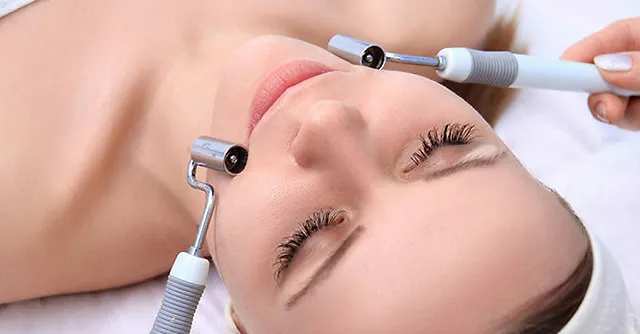
Galvanic current is one of my favourite treatments for a very specific reason: it works at cellular level with a precision that few technologies can match. When I explain to a client that we are going to use electric current on her face, the first reaction is usually surprise. But once I tell her that it has been used in medicine and aesthetics for over 150 years, trust returns immediately. Here's how it works, from our salon in Campo Real, 25 minutes from central Madrid.
What is galvanic current?
Galvanic current is a continuous, low-intensity electrical current that, applied to the skin, produces three simultaneous and complementary effects. It is not the mains current we know at home: it is a continuous, constant, very low-intensity current (milliamps) that interacts with biological tissue in a predictable, controlled way.
The device we use in the salon applies this current through two electrodes: an active one that works on the treated area and a reference one that the client holds or that we place on another part of the body.
The three effects: the heart of the treatment
1. Electrothermal effect
As the current passes through the tissues, a very gentle local warmth is generated in the dermal layers. This warmth has a vasodilator effect: blood vessels dilate slightly, improving local circulation and the supply of oxygen and nutrients to the cells. The visible result is skin that looks pinker, more luminous and with better circulation immediately after treatment.
2. Electrophysical effect
Galvanic current modifies the physical state of the tissues. Specifically, it increases the permeability of the skin and helps mobilise fluids trapped in the tissues. This explains its effectiveness in treating fluid retention in the face (that puffy look many clients wake up with) and in improving skin texture.
3. Electrochemical effect
This is perhaps the most interesting effect from a biochemical point of view. Galvanic current ionises the molecules of the cosmetic products we apply to the skin, giving them an electrical charge. Because the body's tissues have their own electrical charge, these charged ions penetrate far more deeply than they would through simple diffusion.
This process is called iontophoresis, and it is the reason galvanic current multiplies the efficacy of cosmetic actives. A conventional moisturiser stays in the epidermis; applied with galvanic current, its actives reach the dermis.
Who is galvanic current indicated for?
Galvanic current is one of the most versatile facial aesthetic treatments because it can be adapted to virtually any skin type by adjusting the protocol and polarity used:
How often is it recommended?
For maintenance, I recommend one session a month integrated into your skincare routine. For skin with specific concerns (severe dehydration, pigmentation, very dilated pores), a cycle of 4–6 sessions in consecutive weeks produces much faster, more visible changes.
The lovely thing about galvanic current is that it works very well as a complementary treatment to others: it is often combined with a deep-cleansing facial or used as a preparation step before Dermapen.
Combinations that boost results: galvanic + deep-cleansing facial (deeper cleansing), galvanic + radiofrequency (iontophoresis of actives + collagen stimulation), galvanic + personalised mask (maximum absorption of actives).
What it feels like during treatment
The question I always get: "does it hurt?". The answer is no. Galvanic current is felt as a slight tingling in the area where the electrode is working. On very dry skin or in certain areas (such as around the eyes or lips) it may feel a little more noticeable, but always well within the comfort zone.
Many clients drift off during the session. It is, without a doubt, one of the most relaxing treatments in the salon.