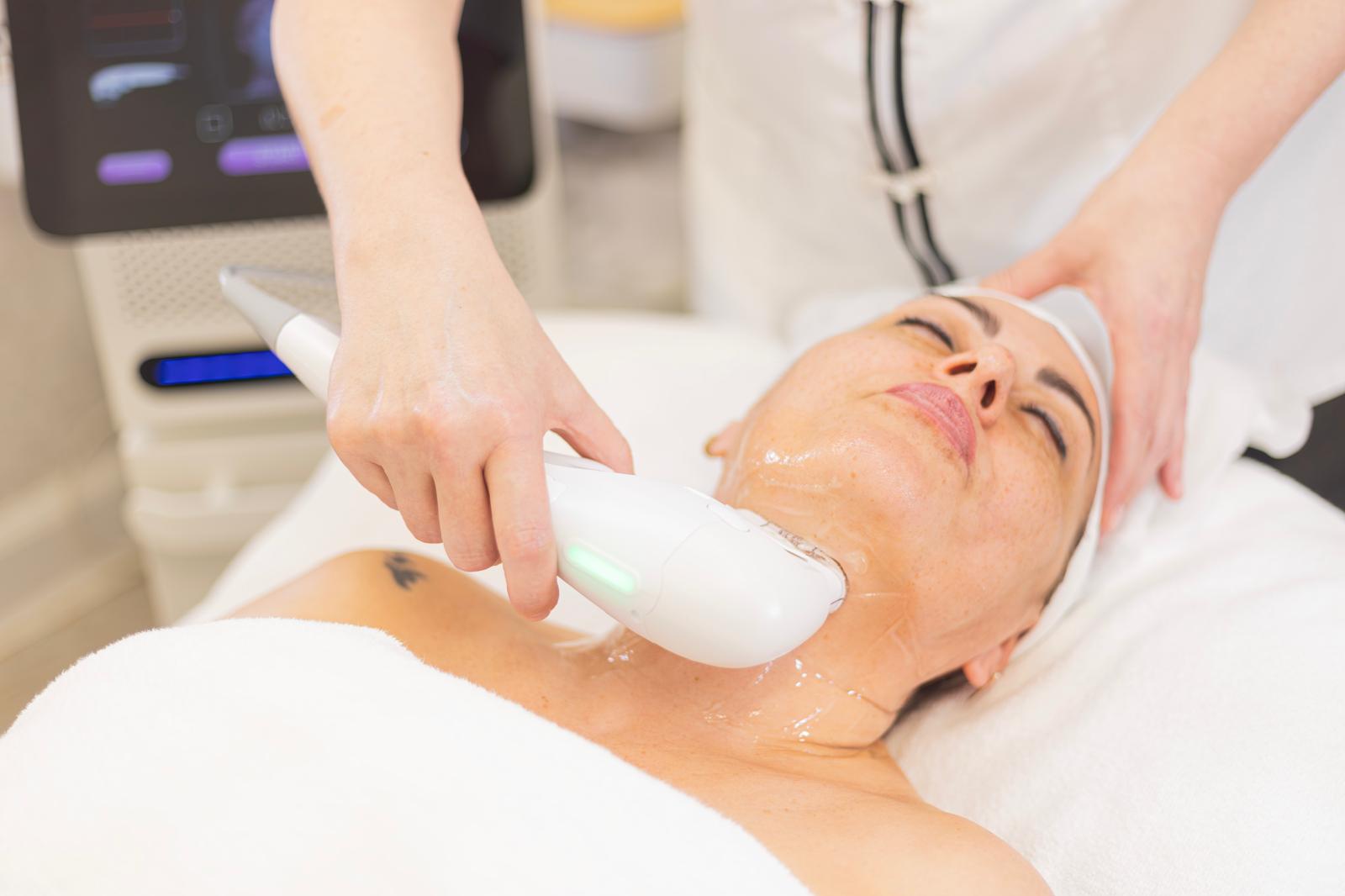
If you've been hearing about HIFU and you're curious — or you already know it and want to understand what changes in the 8D version — this article is for you. Because the difference isn't just the number: HIFU 8D is technologically a generation ahead of conventional HIFU, and the results at our Campo Real salon, just 25 minutes from central Madrid, back that up.
First, the basics: what HIFU is and why it works
HIFU stands for High Intensity Focused Ultrasound. The technology concentrates ultrasound energy at an exact point within the tissue, generating a focused heat of 60–70 °C in that specific area without harming the upper layers of the skin.
That heat produces something no cream can achieve: a controlled thermal lesion in the deep layers that activates the body's natural repair response. The body detects that microtrauma and manufactures new collagen to repair it — type I and type III collagen, the same kind we lose with age and which is responsible for skin firmness and tone.
What makes it unique compared with any other non-invasive treatment is that it can reach the SMAS (superficial musculoaponeurotic system), the very layer surgeons treat in a surgical facelift. No scalpel, no anaesthetic, no downtime.
To grasp the scale: clinical studies published in 2025 show HIFU delivers improvements of 18–30% in skin laxity across the lower third of the face, neck and periorbital area. For a treatment with no invasive intervention whatsoever, those are very meaningful numbers.
What HIFU 8D is and how it differs from conventional HIFU
HIFU 8D takes a step forward in two dimensions that noticeably change both the experience and the result:
1. 8D fan-sweep technology. Where conventional HIFU works with linear shots, 8D uses a system of multiple fan-shaped trajectories that distribute energy more evenly across the whole treated surface. That means fewer untreated zones, more complete coverage and a more uniform result.
2. Combined HIFU + Radiofrequency (RF). The 8D doesn't stop at focused ultrasound: it also delivers radiofrequency that works simultaneously on the more superficial layers while HIFU works deep. Together the two technologies achieve something neither can do alone: stimulation from the surface dermis all the way down to the SMAS in a single pass.
| Feature | Conventional HIFU | HIFU 8D |
|---|---|---|
| Technology | Focused ultrasound | HIFU + Radiofrequency |
| Sweep pattern | Linear | 8D fan, multi-angle |
| Depths | 3–4 depths | Up to 8 depths |
| Coverage | Partial, spot by spot | Uniform, no untreated zones |
| Comfort | Noticeable discomfort per shot | Significantly more comfortable |
| Session time | 60–90 min | 45–60 min |
| Surface result | Limited | RF improves texture and pores |
The 8 depths: from epidermis to SMAS
The big technical advantage of HIFU 8D is its ability to work with millimetric precision across multiple depths in the same session, adapting to each area of the face:
Beyond these four facial cartridge depths, the 8D system carries specific cartridges for the neck (6 mm) and the body (up to 13 mm), which lets us also work the double chin, décolletage and body areas very effectively.
What results it delivers, and when they show
With HIFU 8D the results are progressive. Neocollagenesis (the manufacture of new collagen) is a biological process that takes time, and I'd rather be honest about it:
- Immediately: a light tightening effect from the controlled tissue inflammation. Skin looks a little tauter and the face more defined.
- At 4–6 weeks: the real improvement starts. New collagen begins to organise itself and skin gains density.
- At 2–3 months: optimum result. Visible firmness, more defined contour, improvement of the double chin and marked expression lines.
- Duration: 12–18 months for most clients. With annual maintenance, results hold up very well over time.
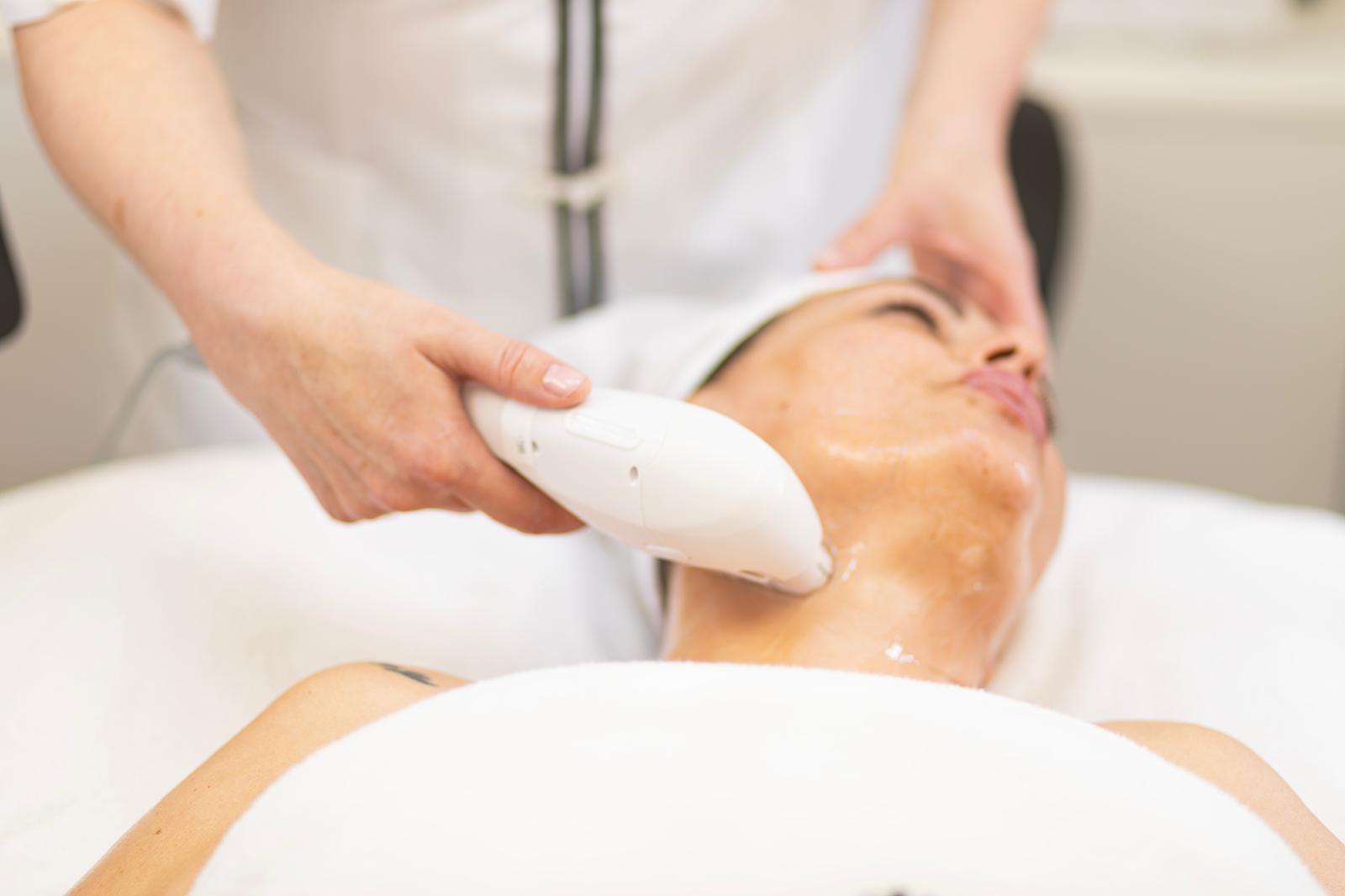
What a session at Esencia Estética looks like
Who is it for?
HIFU 8D is ideal from around 30–35 years old, when the first signs of laxity start to show: a less defined contour, an emerging double chin, a slightly dropping forehead, or lines that used to fade when the face relaxed but now stay put.
It's also an excellent preventive treatment from 28–30 years old, before laxity becomes visible. On more mature skin with established laxity, it remains effective, though it may need more sessions for comparable results.
Recommended combination: for maximum results, we combine HIFU 8D with mesotherapy in the weeks that follow. HIFU works on the deep structure; mesotherapy optimises the surface. Together they cover every layer of the skin and the result is noticeably better than either on its own. Ask me about the combined protocol.
Contraindications: pregnancy and breastfeeding, metal implants in the area, pacemakers, active herpes, recent botulinum toxin treatment (wait at least 3 weeks), active autoimmune diseases, and open wounds or active irritation. If in doubt, message me before booking.
is what you need?
Send me a message and tell me which area concerns you. I'll be honest about whether HIFU 8D is the best option for your case, or whether something else suits your goals better. No obligation.