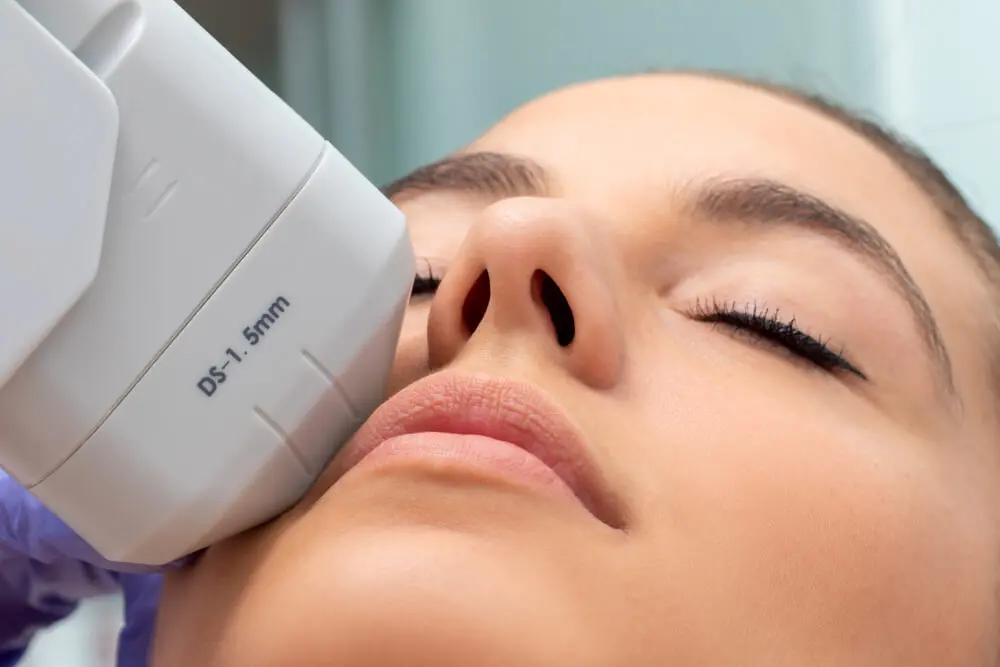
When HIFU first arrived in the aesthetic sector a few years ago, it completely changed the conversation around facial ageing. For the first time, we had a technology capable of working in the same layer that a plastic surgeon lifts during a surgical facelift — but with no scalpel, no anaesthesia and no recovery. HIFU 7D Ultramage is the most advanced evolution of that technology, and today I want to explain exactly how it works — in English, and just 25 minutes from central Madrid.
What is HIFU and what makes it different?
HIFU stands for High-Intensity Focused Ultrasound. It's the same technology used in medicine to treat tumours, but applied at much lower doses and for aesthetic goals.
What makes HIFU unique is its ability to focus energy on an exact point beneath the skin without affecting the upper layers. Think of how a magnifying glass concentrates sunlight on one precise spot: HIFU does the same with ultrasound, but at very specific depths within the tissue.
The SMAS layer: why it matters
The great revolution of HIFU is that it can reach the SMAS layer (Superficial Musculo-Aponeurotic System), located between 3 and 4.5 mm beneath the skin's surface. This is the same layer that a plastic surgeon tightens surgically during a facelift.
Until HIFU arrived, no non-invasive treatment could reach that depth. Creams work in the epidermis. Radiofrequency reaches the dermis. HIFU reaches the SMAS and produces an immediate contraction of the musculo-aponeurotic fibres.
The three working depths of HIFU 7D: 1.5 mm (deep epidermis — texture and pores), 3 mm (reticular dermis — collagen and elastin), 4.5 mm (SMAS — structural lifting effect). The 7D model handles all seven with a single device.
What exactly happens in the tissue?
When ultrasound is focused on a point in the tissue, it generates very localised heat of 60–70°C at that exact point. That heat has two complementary effects:
- Immediate coagulation: the existing collagen fibres contract from the heat, producing an immediate tightening effect visible from the very first day.
- Neocollagenesis: the body interprets that heat point as a "micro-injury" and sends fibroblasts to repair the area, producing new collagen over the following 3–6 months.
The result is a treatment with a dual timeline: immediate (contraction of existing collagen) and progressive (production of new collagen), which keeps improving for months after the session.
What a HIFU session looks like
Real results: what to expect and when
Immediately: visible tightening effect, especially on the facial oval and neck. The skin looks firmer and more "lifted". There may be some redness.
At 2–4 weeks: the lifting effect becomes clearer as the initial swelling (if any) subsides.
At 2–3 months: the peak of results. Neocollagenesis is in full swing and the skin shows maximum firmness, jawline definition and reduction of the double chin.
How long it lasts: results are maintained for 12–18 months depending on age, lifestyle and subsequent skincare. One maintenance session a year is enough for most clients.
Who is HIFU ideal for?
Important: HIFU produces some discomfort during application, especially over bony areas (jaw, cheekbones). Everyone has a different threshold. At the salon we manage this with the appropriate intensity so it's both tolerable and effective. If you're very sensitive, I'll tell you in advance so you come prepared.
- 35–60 with visible laxity
- No metal implants in the area
- Not pregnant or breastfeeding
- Skin in generally good condition
- Pacemaker or metal implants
- Pregnancy
- Active wounds in the treatment area
- Active autoimmune conditions