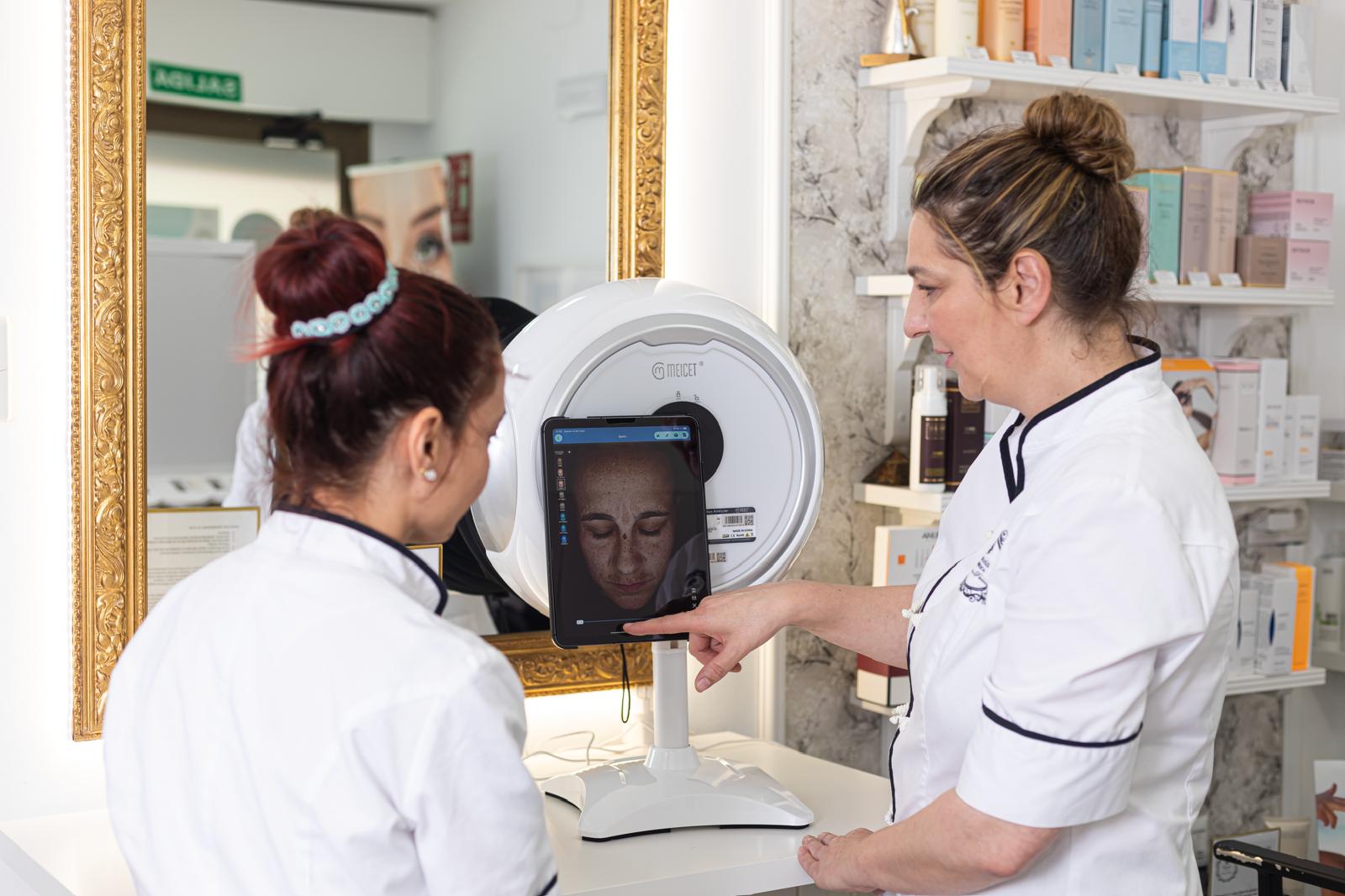
No serious aesthetician will propose a treatment without first understanding what's happening in your skin. The problem is that the naked eye barely sees anything: most of what determines how your skin ages happens in layers the human eye can't reach. That's why we've brought a professional AI facial diagnosis system to Esencia Estética — a high-definition camera plus artificial intelligence, right here in Campo Real (25 min from central Madrid). In this post I'll explain what it does, what we can see, and why it changes the outcome of any treatment that follows.
Why the "clinical eye" is no longer enough
I've been working with skin for over fifteen years, and my trained eye is still the first diagnostic tool. But there are things you simply cannot see without technology: pigmentation forming beneath the epidermis that hasn't surfaced yet, sun damage accumulated in the middle layers, specific dehydration hotspots, the real state of collagen and elastin, or the activity of the sebaceous glands.
The MEICET facial diagnosis system we use combines an ultra-high-resolution camera with several specialist lighting modes (polarised light, UV light, cross-polarised light, infrared) and AI software trained on thousands of skins. The result: a full visual "X-ray" of your skin in just a few minutes.
The key difference: without advanced diagnosis, we recommend by hypothesis ("your skin looks dehydrated"). With diagnosis, we recommend by data ("the perioral zone shows 38% dehydration, sub-epidermal pigmentation is in the malar area, and elasticity in the cheekbone zone is 22% below the average for your age").
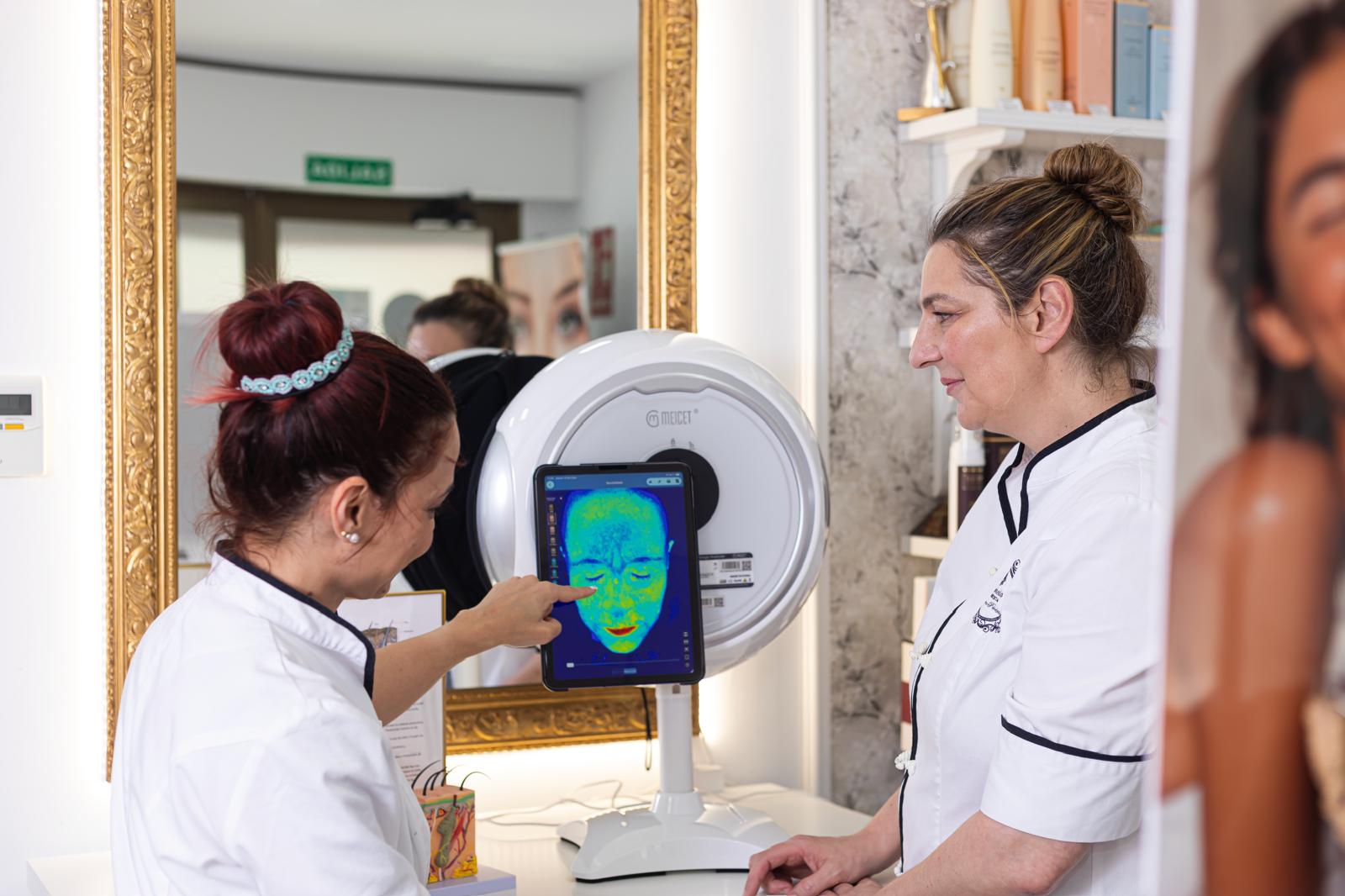
Each lighting mode reveals a different layer: what UV light shows is different from what you see under polarised or cross-polarised light.
The 8 parameters we measure
The device doesn't just take a nice photo. It analyses your skin across eight different dimensions and gives us a numerical value for each one, on top of comparing your skin against the average for people of your age and phototype.
The most useful thing about having all this data isn't the photo itself: it's being able to repeat the analysis in 3 or 6 months and compare. Seeing with numbers what has improved after treatment, what needs more consistency and what has to be approached differently. Diagnosis isn't a one-off moment: it's the foundation for real, ongoing follow-up.
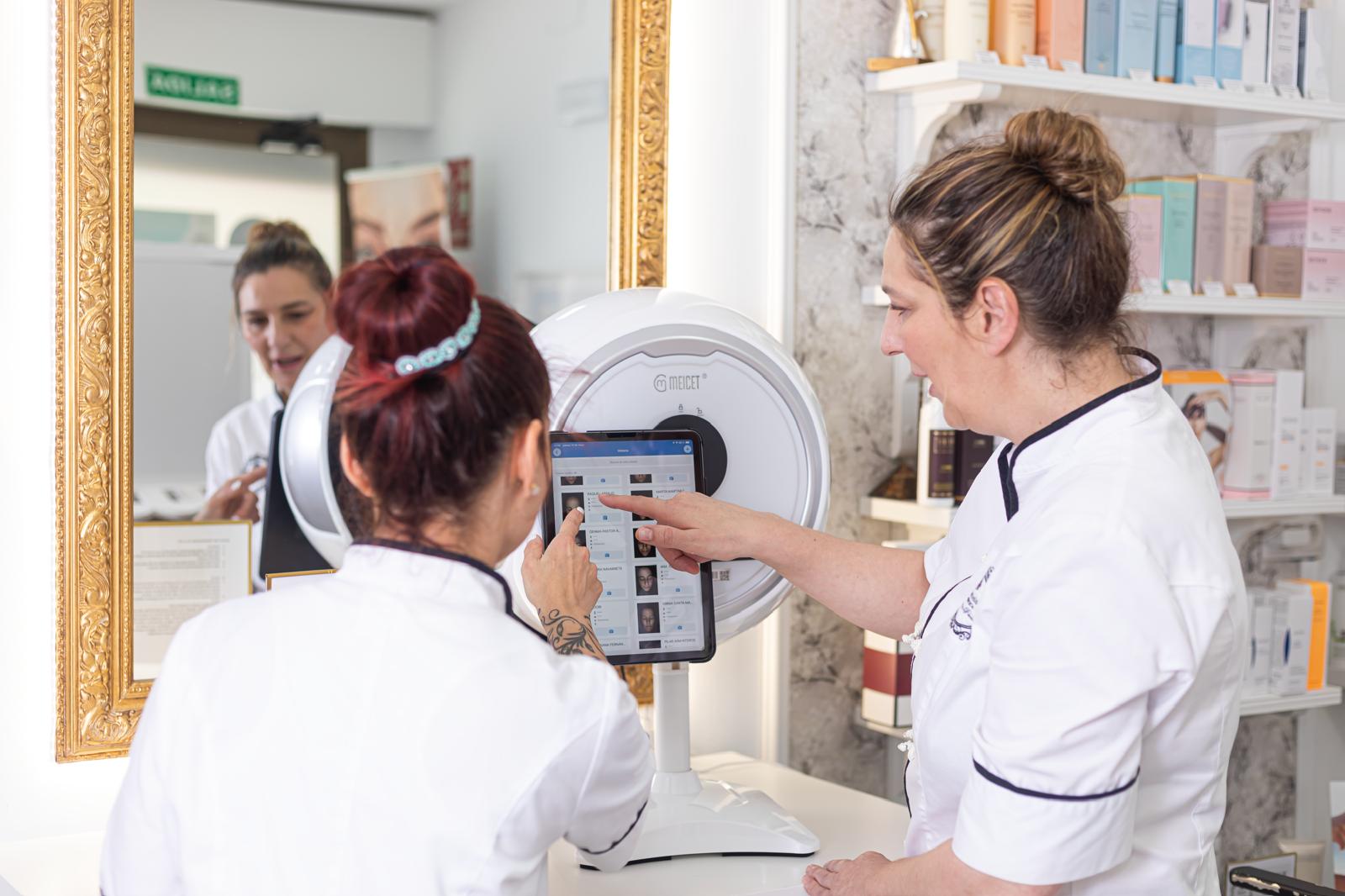
Your client file stores the history of every analysis. We compare visually and numerically how much each parameter has improved between sessions.
What the diagnosis session looks like
Which treatments change most with a prior diagnosis
Any facial protocol improves when we start with an advanced diagnosis, but in some cases the difference is huge:
- Pigmentation treatments: without diagnosis, we treat what we can see. With diagnosis, we also target spots still forming below the surface — and gain months of head start.
- Deep-cleansing facials and Dermapen: we know which zones actually need extraction and which don't, avoiding any unnecessary aggression on the skin.
- HIFU and radiofrequency: we measure elasticity before and after. The before-and-after stops being a sensation and becomes data.
- Mesotherapy and Hydrafacial: we personalise the exact actives according to the areas of greatest dehydration or loss of radiance.
- At-home skincare: we recommend creams and serums based on what the skin really needs — not the generic routine for your phototype.
Why we've brought this technology in
Investing in advanced diagnostics is the foundation of any serious treatment. If you can't see well, you can't treat well.
Professional aesthetics has changed enormously in recent years. The brands we work with — Skeyndor, Alissi Brontè, Selvert Thermal — invest every year in research, scientific dermocosmetics and new actives. If in the treatment room we're still diagnosing "by eye" alone, we throw away all that knowledge. Advanced diagnosis is what connects the science behind the products to the specific reality of your skin.
We've been training ourselves in reading diagnostic reports, attending specific master classes and working directly with the equipment's manufacturer to get everything out of its algorithms. Because owning a good machine is worthless if you don't know how to interpret what it shows you.
My personal recommendation: if you've never had an advanced diagnosis, I encourage you to try it even if you're not planning to start a treatment. Seeing your skin "from the inside" — and understanding what you see — is an experience that changes how you look after yourself. And the first consultation is free, with no obligation.
Important: facial diagnosis is an aesthetic analysis, not a medical one. It doesn't replace a dermatology consultation. If we detect a lesion or a suspicious change, we always refer you to a dermatologist.
Book a professional facial diagnosis session. In 30–40 minutes you'll have a full analysis of your skin, a personalised report and a treatment plan tailored to what your skin actually needs. The first assessment is free, with no obligation. Fully English-speaking, 25 minutes from central Madrid.